
Smart Lighting for Your Home: Scenes and Savings
Smart lighting with Control4 in Guayaquil, Ecuador: scenes, dimming and sensors that set the mood and save energy at home.

Lighting dictates the mood of a home. It’s the element that can most easily and dramatically change how a space is perceived: the same rooms feel completely different with well-designed lighting versus bad lighting.
Smart lighting with Control4 and the best brands goes far beyond simply being able to turn lights on and off from your phone. It’s about creating atmospheres, saving energy intelligently and simplifying everyday life with automations that work invisibly.
What Makes a Smart Lighting System Professional
The market has everything, from Wi-Fi bulbs controlled with an app to systems designed to run the whole house. The difference isn’t being able to switch a light on from your phone; it’s the quality of the dimming, the reliability of the system and how well it integrates with the rest of the home.
The technical criteria we apply when choosing the equipment for each project:
- Smooth, stable dimming across fixture types: dimmable LED, halogen and incandescent, with no flicker or abrupt jumps
- No-neutral options (making installation in existing electrical boxes easier)
- Reliable communication between dimmers, scene keypads and sensors, in both wired and wireless systems
- Native integration with Control4, so lighting works together with audio, climate, motorized shades and security
Lighting Scenes: The Feature That Changes Everything
The concept of a “scene” is the most valued feature of smart lighting. A scene is a saved configuration that defines the level and color temperature of multiple fixtures at the same time.
“Welcome” Scene
When you arrive home in the evening:
- Entrance lights at 60% (warm)
- Hallway lit at 40%
- Main living room at 50% with a warm temperature
- Kitchen at 70% (ready to prepare dinner)
All of this happens automatically when the system detects your arrival (geolocation or door-opening sensor).
“Cinema” Scene
When you start a movie:
- Living room lights fade gradually to 5%
- Accent light behind the television (bias lighting) at 20% in a neutral tone
- Hallway lights at 10% so the kids can go to the bathroom without tripping
- The rest of the house stays unchanged
“Romantic Dinner” Scene
For special occasions:
- Dining room at 25% with a very warm temperature (2700K)
- Electronic table candles in amber
- Living room at 15%
- Kitchen off or very low
- Romantic music activated in the corresponding zones
“Focus” Scene (Home Office)
While working from home:
- Office at 80-90% with a cool temperature (5000K, simulating daylight)
- Rest of the house in lower or automatic modes
- No flicker or glare to cause eye strain
“Good Night” Scene
When going to sleep:
- From the keypad next to the bed, a single tap turns off every light in the house
- Only the hallway stays at 5% as a nighttime emergency light
- The bedroom stays completely dark
Energy Efficiency with Smart Lighting
Lighting accounts for a meaningful share of a home’s electric bill. Smart lighting helps reduce that consumption in several ways:
Professional Dimming
With good dimming, each fixture operates at exactly the level you need. A living room you’d normally use at 100% during a gathering can use much less energy during a movie evening. Over time, these savings add up.
Also, LED bulbs tend to last longer when they operate at lower intensity, which reduces how often they need replacing.
Presence and Occupancy Sensors
Presence and occupancy sensors integrated into the system detect motion in each room. If no one is in the guest bathroom, the lights turn off automatically. In hallways and circulation areas, the lights turn on when someone passes and turn off 5 minutes later.
The impact of this simple automation can show up in monthly electricity consumption, especially in homes with domestic staff.
Timing and Schedules
Garden lights are programmed to turn on 15 minutes before sunset and turn off at dawn, adjusting automatically with the change of seasons. Decorative Christmas lights or any outdoor lighting can have independent schedules without anyone having to remember to turn them on or off.
Lighting Control Options for Your Project
Zone Control for Finished Homes
The entry-level solution for finished homes, or for starting with the main living areas. Dimmers and scene keypads install in standard electrical boxes (there are no-neutral options) and are controlled from the Control4 app or the keypads themselves. Ideal for residential projects without dedicated data wiring for lighting.
Whole-Home Lighting Control
For large residences with many zones, the system is sized to cover the entire house with complete Control4 integration: every dimmer, keypad and sensor takes part in the same scenes, schedules and automations as the audio, climate or security. It’s the standard in DomuLab residential projects.
Both options can be delivered as wireless systems for renovations or wired systems for new builds, as explained below.
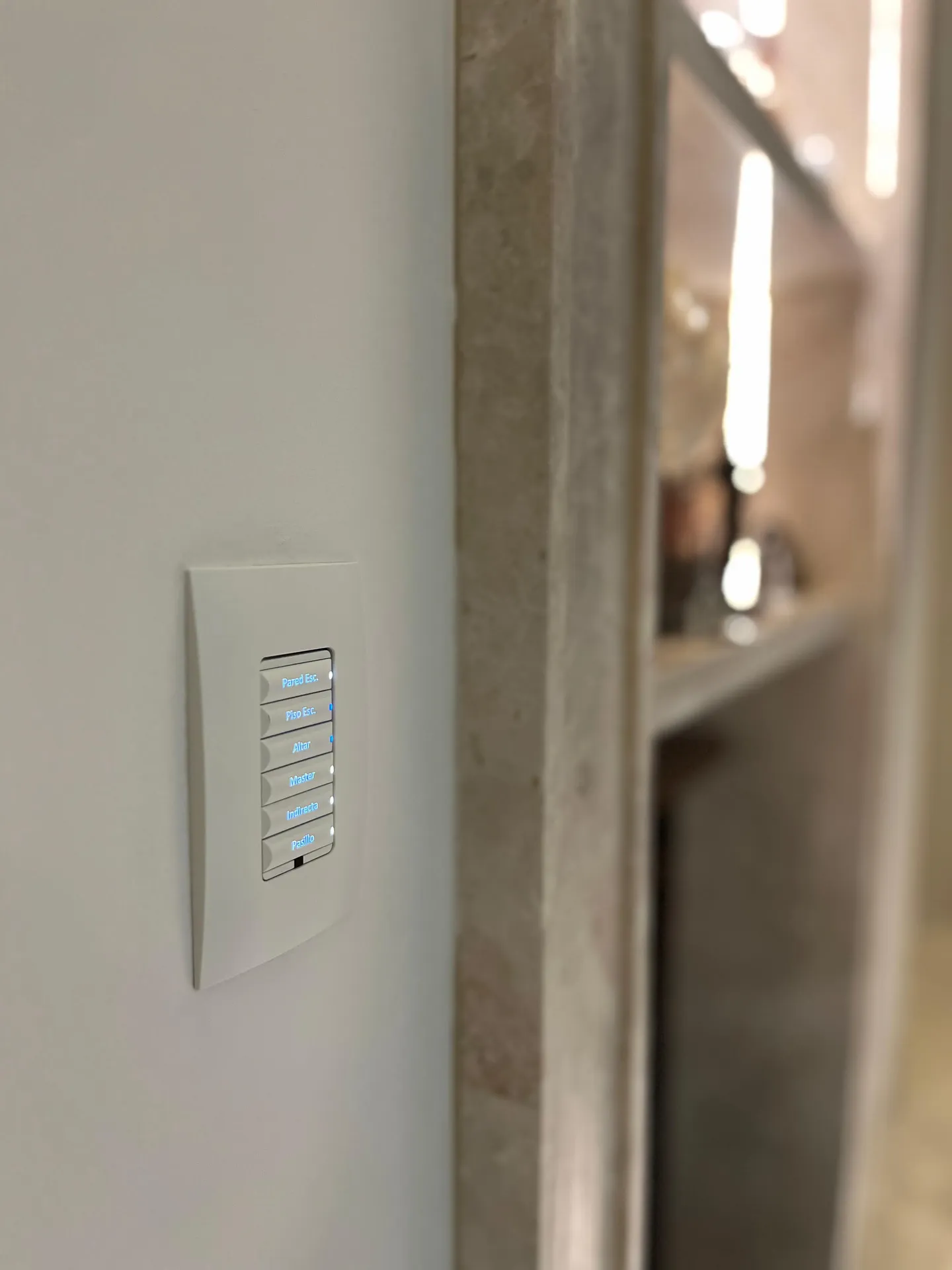
Scene Keypads: Design That Complements Architecture
Scene keypads are the visible part of the system, so we choose them with the same care as any other interior finish. The premium lines we install offer:
- Finishes in glass, brushed metal and premium materials
- Buttons with no visible text or with custom engraving
- Different button layouts within the same design line throughout the house
- Customization of actions per button (dimming, scenes, sequences)
These keypads aren’t just functional: they are design elements that elevate the visual perception of any space.
Integration with Natural Light
Together with motorized shades integrated with Control4, the system can manage natural light intelligently:
- The shades open gradually at dawn for a natural wake-up
- During midday, they partially close to reduce heat and glare
- At sunset, they close for privacy and the system activates the artificial lighting
- On cloudy days, the system raises the indoor lights to compensate
This coordination between natural and artificial light is what’s called daylight harvesting and can noticeably reduce artificial lighting consumption.
Installation in New Construction vs. Finished Home
In new construction: a wired system is the ideal choice. Specific conduits and junction boxes for the lighting control modules are installed before plastering. The cables run from the lighting boxes to the technical rack where the control modules are installed. The result is a completely invisible installation.
In a finished home: a wireless system allows installation with minimal intervention in walls. The dimmers install in existing electrical boxes and communicate wirelessly with the central controller. In many cases there’s no need to open walls.
Want to transform your home’s lighting in Ecuador? Book a demo at your own property.
Need the luminaires defined as well as the control? Our Lighting Line covers lighting design, specification, and supply of architectural luminaires for the project.